
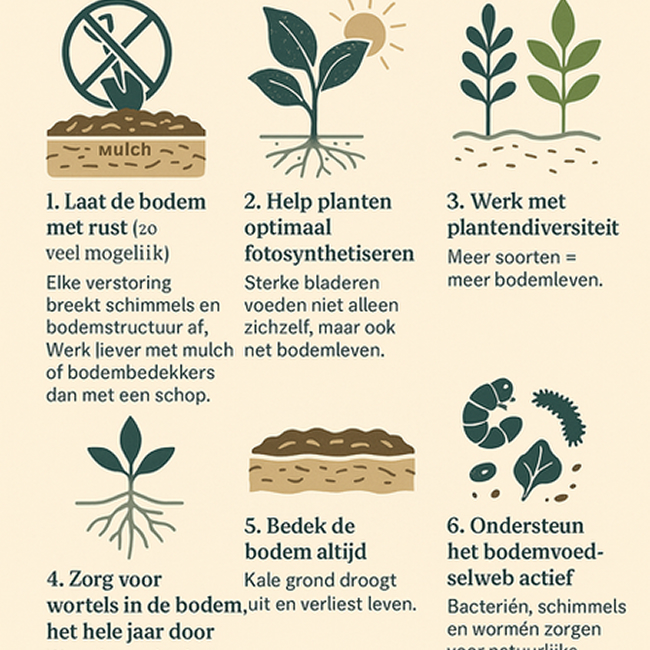
Healthy plants thrive in living soil. But such soil requires care, insight, and patience. Here are six keys to making your soil resilient, nourishing, and teeming with life.
1. Leave the soil alone (as much as possible)
Any disturbance breaks down fungi and soil structure. It’s better to work with mulch or ground cover than with a shovel.
In concrete terms: Use mulch in your garden to protect and nourish the soil.
2. Help plants photosynthesize optimally
Strong leaves nourish not only themselves but also the soil life. The healthier the plant, the stronger the soil cycle.
In practice: Apply foliar fertilization where necessary for rapid support of the chlorophyll.
3. Work with plant diversity
More species = more soil life. Variety in plants attracts different microbes and builds balance.
In concrete terms: Consider sowing green manures or various cover crops, especially in autumn/winter.
4. Provide roots in the soil all year round
Roots constantly nourish soil life with sugars and signals. They are essential even outside the harvest season.
In practice: sow cover crops in winter or work with perennial species.
5. Always cover the bottom
Bare soil dries out and loses life. Covered soil stays moist, cool, and active.
In practice: Apply mulch or let plants cover the soil all year round.
6. Actively support the soil food web
Bacteria, fungi, and worms provide natural nutrition. You can support these.
In concrete terms:
– Test your soil for fertility (CEC) and mineral profile. You can also additionally test the soil biology.
– Add minerals or amendments where necessary.
– Apply compost, microbial inoculants and/or compost tea to enhance soil life (and biology).
In a food forest, we build on these principles; they also apply to your own garden or farm.
We have every opportunity to care for and restore our soils!