
Steps to a sound food forest design
– Step 2 – Observing your terrain 🌿👀
A good food forest design is created by understanding what already exists. Observation helps you read the terrain and discover its natural dynamics. While preliminary research sketches the initial contours, observation reveals the deeper layers of the site.
Why is observation crucial?
Observation reveals microclimates, water flows, soil life, and the relationships with the environment. It teaches you how the site behaves over time and what functions the food forest should fulfill. By observing carefully, you avoid incorrect assumptions and lay the foundation for a resilient design.
🔍 Two forms of observation
🌿 Passive observation: look without judgement
This open, mindful observation is the first and perhaps most important step. We open all our senses and observe without immediately interpreting.
✨ How do you approach this?
- Walk the grounds with the curiosity of a first-time visitor.
- Walk the borders: here you discover the relationship with the environment and there is often a lot of life to be found.
- Relax, listen, and feel. What impressions and thoughts arise?
- Observe without judging. What do you notice when you ‘re just there?
💡 Pro tip: Inform the owner to create a quiet space. Silence and tranquility enhance this form of observation.
🌿 Targeted observation: research with a purpose
After the open exploration, you will specifically search for concrete information that is important for your design.
🔍 What do you pay attention to?
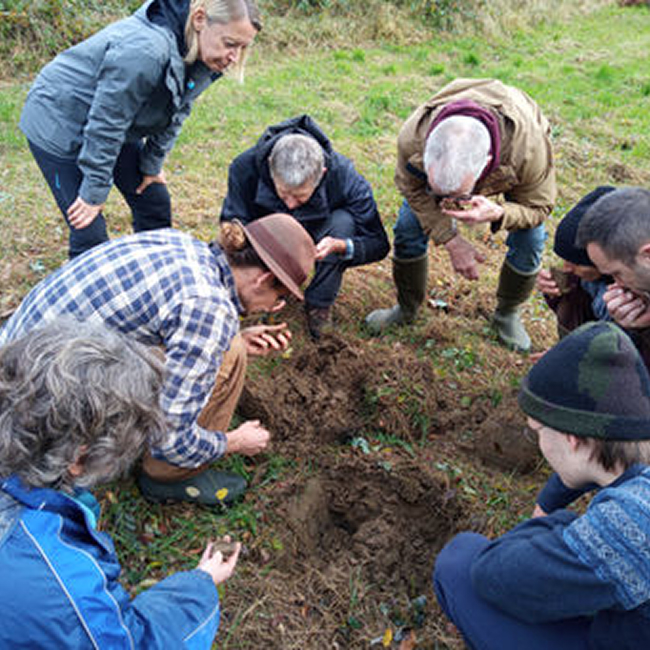
- Soil profile: Dig a soil profile pit to learn about the structure and properties of the soil.
- Fauna and flora: Which plants grow spontaneously? Indicator plants reveal a lot:
- Nettles ➔ nitrogen-rich soil
Willow ➔ wet zones
Blackberry fields ➔ indicate a next step in the succession - Water flows and relief: How does water flow? Where are the wet and dry areas?
- Wind and microclimates: Which zones are sheltered or open?
- Accessibility and fixed structures: How do people move around the site? Where are the logical routes?
📷 Pro tip: Record your findings with photos, videos, and sketches. This way, the information will remain available in later design phases
🍃 Observation through the seasons
A terrain lives and changes with the seasons. Observations at different times provide insight into:
- Sun and shade: Where does the sun fall in summer and winter?
- Water management: How does water discharge change in wet or dry periods?
- Seasonal Flora: Which plants appear or disappear during the year?
- Wind patterns: Are there seasonal differences in wind direction or strength?
💡 Pro tip: When you can observe a site for at least a year, you get a much richer picture for a robust design.
✨ During our course, we’ll take ample time to observe, both passively and purposefully. By exploring the site together, we’ll learn how design choices emerge from what the terrain tells us.
Follow this series and discover how we work step by step from idea to reality.Steps to a sound food forest design
– Step 2 – Observing your terrain 🌿👀
A good food forest design is created by understanding what already exists. Observation helps you read the terrain and discover its natural dynamics. While preliminary research sketches the initial contours, observation reveals the deeper layers of the site.
Why is observation crucial?
Observation reveals microclimates, water flows, soil life, and the relationships with the environment. It teaches you how the site behaves over time and what functions the food forest should fulfill. By observing carefully, you avoid incorrect assumptions and lay the foundation for a resilient design.
🔍 Two forms of observation
🌿 Passive observation: look without judgement
This open, mindful observation is the first and perhaps most important step. We open all our senses and observe without immediately interpreting.
✨ How do you approach this?
- Walk the grounds with the curiosity of a first-time visitor.
- Walk the borders: here you discover the relationship with the environment and there is often a lot of life to be found.
- Relax, listen, and feel. What impressions and thoughts arise?
- Observe without judging. What do you notice when you ‘re just there?
💡 Pro tip: Inform the owner to create a quiet space. Silence and tranquility enhance this form of observation.
🌿 Targeted observation: research with a purpose
After the open exploration, you will specifically search for concrete information that is important for your design.
🔍 What do you pay attention to?
- Soil profile: Dig a soil profile pit to learn about the structure and properties of the soil.
- Fauna and flora: Which plants grow spontaneously? Indicator plants reveal a lot:
- Nettles ➔ nitrogen-rich soil
Willow ➔ wet zones
Blackberry fields ➔ indicate a next step in the succession - Water flows and relief: How does water flow? Where are the wet and dry areas?
- Wind and microclimates: Which zones are sheltered or open?
- Accessibility and fixed structures: How do people move around the site? Where are the logical routes?
📷 Pro tip: Record your findings with photos, videos, and sketches. This way, the information will remain available in later design phases.
🍃 Observation through the seasons
A terrain lives and changes with the seasons. Observations at different times provide insight into:
- Sun and shade: Where does the sun fall in summer and winter?
- Water management: How does water discharge change in wet or dry periods?
- Seasonal Flora: Which plants appear or disappear during the year?
- Wind patterns: Are there seasonal differences in wind direction or strength?
💡 Pro tip: When you can observe a site for at least a year, you get a much richer picture for a robust design.
✨ During our course, we’ll take ample time to observe, both passively and purposefully. By exploring the site together, we’ll learn how design choices emerge from what the terrain tells us.
Follow this series and discover how we work step by step from idea to reality