
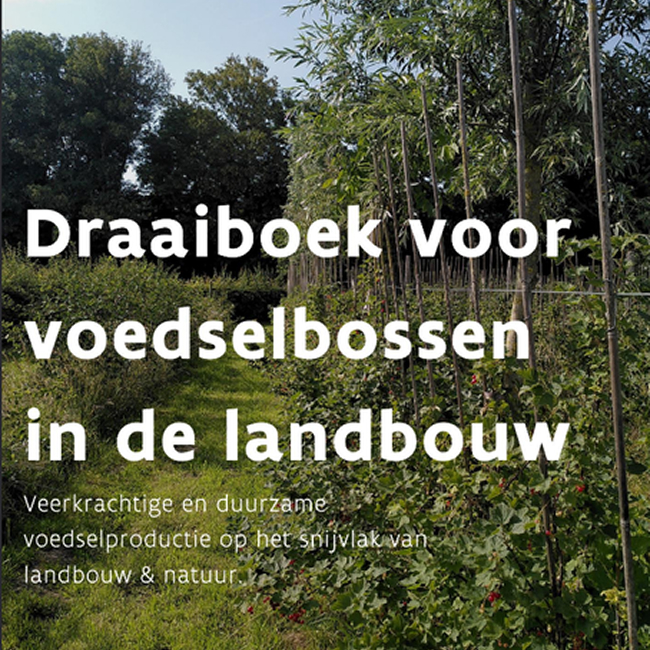
The call for regenerative agriculture is growing. More and more people want to create food forests—among other things for soil development, healthy production, biodiversity, and community building. But legally, food forests often remain in a gray area.
🟢 Are you a certified farmer?
Then there is a clear route. As a farmer, you are allowed to create a food forest on agricultural land, even with more than 200 trees per hectare. To do so, you must submit a substantiated application to the Flemish Land Agency (VLM) . In this application, you demonstrate that the food forest is an integrated part of your agricultural activity: that it produces harvests (fruit, nuts, wood) and is managed within a business operation. After approval, you may plant, and you may be able to apply for subsidies for planting and maintenance under the BLS/BLO framework .
Are you not an active farmer and do you not want to fall under the Forest Decree ?
Then things get more complicated. Food forests are not yet recognized as a separate use in policy. They are neither a classic fruit grove nor a formal forest. In practice, after 7 to 15 years, canopy closure often occurs , meaning the plot automatically falls under the Forest Decree . It is then considered afforested, with all the ensuing consequences: permits for interventions, management restrictions, and a change in the official land use.
In such a case, drafting a nature management plan can be a way to legally anchor the management. But even that remains a workaround for now. As long as there is no clear policy recognition for food forests, many pioneers will continue to operate in a legal vacuum.
🌱 Who among you has already submitted a proposal (>200 trees/ha) to the VLM (Flemish Environment Agency) and had it approved? Or who chose to designate the food forest as afforestation and have it included in a nature management plan?
I’m happy to collect practical examples—feel free to share your experience in a comment or private message. Do you have a project in the pipeline and want more information? Check out Food Forward’s final report or contact me via private message.